Showing posts with label social media. Show all posts

Thursday, 25 March 2010

They're getting ready for 2012. Are you?


Harrow residents have decided to get ready for the 2012 London Olympics...their own way! They are no longer willing to passively sit around their living rooms watching all the action take place on TV. They want in on the action! So with whatever knowledge they have and with the equipment at their disposal they've started to seriously train for the sporting event of their choice. Whether it's swimming, gymnastics or tennis, members of the Harrow community have taken it upon them to become the most active borough in London and the best prepared for the grand international event of 2012. And we have the video to prove it!


For more information visit:
www.twitter.com/harrowfor2012
http://www.facebook.com/group.php?gid=105233642840533
www.youtube.com/harrowfor2012

P.S. Big thank you to Babusha and Menglu for getting out of bed at an inhuman hour on a Saturday and running in the rain...several times; to Filippo for getting down and dirty in the rain and making friends with the mud...several times; to Sarah and Street for taking time out of their busy life to be awesome; to Menglu for borrowing me her camera, but most importantly..the egg!; and to Jayne for letting me borrow me her amazing kids!! (I'd offer to babysit but I feel like I might need a babysitter of my own to get the job done:P)

Add To Google BookmarksStumble ThisFav This With TechnoratiAdd To Del.icio.usDigg ThisAdd To RedditTwit ThisAdd To FacebookAdd To Yahoo

Friday, 19 March 2010

"Social media: as you can see we're learning as we go. Thanks for the comments."


"Need a break? So does the rainforest" is the latest Greenpeace campaign against Nestlé, who they accused of using palm oil in their Kit-Kat recipes, from companies that are 'trashing Indonesian rainforests, threatening the livelihoods of local people and pushing orang-utans towards extinction.' 

The above video went viral almost instantly,with almost 200,000 views on YouTube alone, and it made critics take Nestlé Facebook page by storm, flooding it with complaints and accusations of unethical behaviour.


And that's when the series of bad decisions by Nestlé started, showing off the ugly side of social media and the tremendous repercussions it can have on a brand, accounting for a true PR disaster for the company.

First bad move that they made was asking for the video to be removed, citing copyright claims. If the company is so worried about their image, shouldn't their first priority have been severing ties to the rainforest destruction actions that they are responsible for? Because, let's face it, nothing good can ever come out of trying to hide the trash under the rug.

More even, Nestlé can learn a lesson in social media from Greenpeace who, immediately after the video was taken down from YouTube, posted it on Vimeo and used Twitter and other platforms to spread word about Nestlé's censorships attempts. They eventually got the video re-uploaded on YouTube and the story made every national and local newspaper, whether in print or online.

Administrators of the Nestlé Facebook page didn't really do a good job either of accommodating the influx of negative comments. Among their responses we saw:


"…we welcome your comments, but please don't post using an altered version of any of our logos as your profile pic - they will be deleted.
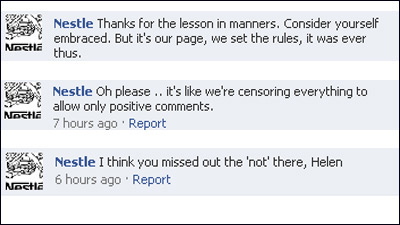
"Thanks for the lesson in manners. Consider yourself embraced. But it`s our page, we set the rules, it was ever thus." 
"Oh please .. it's like we're censoring everything to allow only positive comments." 

Not even in the face of the disaster that was their Facebook page at the moment could they accept that they had completely lost control over their corporate social media communications. Snapping back at your commentators, trying to impose your rules cause it's your playground they're in, is never the right course of action. And these snarky Facebook comments only succeed in infuriating users further. Nestle's entire social media crisis response strategy was a huge fail, showing off their lack of preparation or planning for such a situation. At the moment the company has over 95,000 fans on their Facebook face, a great number of which joined solely to write their complaints and thoughts surrounding the situation. The final count was of over 120,000 negative comments agains the company's actions.

The first sensible thing posted by Nestlé throughout the entire situation was "Social media: as you can see we're learning as we go. Thanks for the comments." It may, however, have come a bit to late. 

Things got even worse on Twitter, where the company has a whooping 9 followers!(why do they even bother having a Twitter account in the first place when engaging in a conversation with users is definitely not in their intention?) The only response on this social media platform from Nestlé was a link to a statement on their website. They totally missed out on the opportunity of starting a dialogue with their followers, answering their questions and calming down the situation. 

As Ian Duff, a spokesperson for the Greenpeace campaign against Nestlé, correctly observed: "Nestlé have brought this outrage onto themselves." By being completely unprepared and incapable of correctly managing their social media platforms. And the problems were not only brought on by the crisis situation Greenpeace threw them in. The roots ran deeper, into an dreadful social media strategy, which is unacceptable for a corporation of the likes of Nestlé. 

This Nestlé PR disaster should be a lesson for all corporations, big or small, on the power of social media, and how easily it can turn against you. However, the Greenpeace case should also stand out as a best practice case of how to use the power of social media for your cause. Social media doesn't have to be something than companies should fear and avoid. But it should be something treated with all seriousness and any social media strategy should be thoroughly though out, planned and implemented within a clear framework or rules and practices. 


Add To Google BookmarksStumble ThisFav This With TechnoratiAdd To Del.icio.usDigg ThisAdd To RedditTwit ThisAdd To FacebookAdd To Yahoo

Tuesday, 16 March 2010

Political PR - between blunders and success

"Politics is war without bloodshed, while war is politics with bloodshed" - Mao Zedong 

Our debate this week, which was, in my opinion, one of the best we've had so far, focused on whether “Political PR has undermined public trust in politicians and is the single biggest threat to our democratic health.”
It's not far-fetched at all for such a negative connotations to exist around political PR, especially since the term if formed by two words that denominate professions with severe image problems. And, as in the case of PR (couldn't really say this about politics as well, but then again that is not my field), a lot of it is due to misconceptions and misperceptions. This is not to say that there isn't any truth in the critics raised to the profession and some of its less ethical practices.

I'm not going to go into the controversial issues surrounding political PR and the Iraqi of Afghan war for example; certainly bad things happened there, lies were told that were uncovered and made the public lose trust in politicians and PR played a huge role in all of it. There is no denying any of that. But that can't be all that we reduce political PR to.

Political PR could represent a good starting point for engaging governments into two-way communications with their audiences - the people who elect members of Parliament, Prim-Ministers and Presidents, and ultimately suffer the consequences of those people's decisions, whether good or bad. Voters want to be better informed and to feel more involved in the election process, and political PR can help them better understand the candidates and their messages; this also means that the messages would become much better targeted at the correctly identified audiences.


Social media is also a factor to be considered in this discussion, as it is view by many as the foundation of a new, extremely transparent two-way communication model; and governments, political parties and candidates have began making use of it, some very well and some not so well, in their dialogue with the voters. The rapid, direct feedback obtained through the use of social media channels can help politicians better understand communities' needs and requirements. And the community members will feel that they are being listened to, not just talked at.

For me, in the debate, it was the team arguing against the statement that brought stronger and more to the point arguments in their quest to prove the political PR can also prove to be very valuable and useful within the democratic mechanism of a country.

This topic also led us to an interesting discussion surrounding the 2008 US elections, which proved to be quite revolutionary in terms of techniques and platforms used, and how they might influence the upcoming 2010 UK elections. Obama has been called the 'Twitter president' and his team's use of web 2.0 strategies during the elections, apart from innovative and revolutionary, have played a huge role in getting him in the position that he holds today. Now, as the British elections tend to follow the American campaigning patters, we were all expecting to see how Cameron & co use the social web. So far I would say they aren't getting very far. Maybe they are not using it properly or the public is not as receptive to it - either way social media hasn't given any of the candidates a clear advantage so far, nor has it been an integral part of their campaigns. My guess is that the first scenario is more likely, as most Twitter activity so far has been focused on making attacks against the opponents and defending themselves from their attacks.


All in all, UK candidates have not been as successful at implementing social media strategies and it would seem that, for now, the 2008 US elections and Obama's campaign and the tools used to gather votes, in particular, will remain a singular benchmark moment in the history of modern elections.


Add To Google BookmarksStumble ThisFav This With TechnoratiAdd To Del.icio.usDigg ThisAdd To RedditTwit ThisAdd To FacebookAdd To Yahoo

Sunday, 7 March 2010

IQ PR ANNOUNCES LAUNCH OF REVOLUTIONARY SOCIAL MEDIA WEBCAST

More than a fad, social media has become a strategy for success in today's business environment

03.07.2010 – IQ PR has launched today a revolutionary webcast about social media aimed at helping organisations and individuals better understand and more efficiently use it within their business or daily activities. The webcast was produced by Roxana Tintea, Client Social Media Strategies within the agency, and is designed to clarify all the changes that the digital age, and especially social media, has brought to the business environment.

Social Media Revealed

The 10 minute webcast takes the viewers through:

• what social media is - perspectives
• why it is called social media and the relevance of social sciences
• what the main sociological and cultural concepts behind social media are and their connection to public relations
• how IQ PR is using social media for its clients - from SEO services to PR strategies
• what the benefits of using social media for businesses are - from consumer engagement to identifying your audience's needs
• what some of the downsides to social media are and how they could be countered.
Even with the existing downsides, having a social media strategy has become a must for business in every field. Why? Because conversations about your brand or business are taking place with or without you. Organisations need to take part in these conversations to be able to give the consumers the right answers, provide them with the correct information and avoid potential crises.

Ignoring the existence of social media has become a strategy for failure. Engaging with customers and sharing in the dialogue shows the company is transparent, it listens, it responds and it cares.

The webcast can be found on the agency's blog, its YouTube channel or through Digg and the agency's Twitter feed.

Online voices

Roxana Tintea, creator of webcast and Social Media Strategist: "I wanted people to get a better sense of what social media really is and what it can do for them as individuals or for their business. I think that this webcast sheds a lot of light on some the issues that have been raised about social media lately and could prove to be useful not only to our clients, but to the entire PR industry and the social media community."

IQ PR executive manager, Julie Renee Davis: "This webcast provides our clients, and not only, with the answers to every question about social media that they've ever been faced with. We are very excited to be able to share this unique resource with the PR and social media industry and wish to continue this initiative with a series of webcast on related topics."

Thomas Venon, social media expert at SocialMediaToday: "I am delighted to see that IQ PR identified the need of such a material within the industry and managed to do such a great job in creating it. The webcast provides valuable insight in social media matters and it's a must see for everyone in the industry."

Notes for editors

• The webcast's transcript is available for download on the agency's blog .
• For a downloadable version of the webcast please contact the press officer at socialmedia_pr@yahoo.com.
• For more information please see the SMPR at PitchEngine.com
 
Contact
IQ PR
21, Flower Road, London, SW7
Phone: 020 8009001, Fax: 020 9008009

Roxana Tintea, Client Social Media Strategist
Phone: 020 7895674, Mobile: 0735 4567890
E-mail: roxanatintea@yahoo.com
Blog: http://www.contemporarypr.blogspot.com/
Add To Google BookmarksStumble ThisFav This With TechnoratiAdd To Del.icio.usDigg ThisAdd To RedditTwit ThisAdd To FacebookAdd To Yahoo

Crisis management in the digital age

Over the past few years, social media has had an impact, whether bigger or smaller, on people, communities and businesses and has brought certain undeniable changes with it. Even if its revolutionary and groundbreaking effects have been exaggerated by some, one thing that social media has definitely transformed is the way in which we communicate with each other. Which means that the way we discover information and share it is also transforming.


Today's social channels are more influential and powerful than their predecessors and they insure the rapid diffusion on public opinion. In this new digital age, news of a negative event or incident has the potential to spread faster that any crisis experienced by previous generations has. All of these things lead to organisations modifying not only the way they are handling, planning and implementing crisis management, but also the way they perceive and understand what a crisis is.

One of the first things that companies need to figure out is what they define as being a crisis on the web; what is the tipping point when an online event triggers or develops into a crisis for that organisation? Once that is cleared up they can start thinking about planning, both proactive and reactive, for the appropriate crisis management solutions.


Two years ago, Brian Solis talked about reinventing crisis communications for the social web and suggested that "many, if not a majority of potential crises are now avoidable through proactive listening, engagement, response, conversation, humbleness, and transparency." The crisis management model he put forward is based on listening, observation and conversation:


This model is a proactive one that aims at reducing the need for reactive responses and crisis communications programmes.

Monitoring becomes absolutely essential in the social web and companies must be sure to set up 'digital listening posts' on all relevant platforms. It is essential to have social media channels set up and the more credible they are (number of followers or friends, quality of information), the better the company will be able to make use of them in a crisis situation or for the prevention of such an event.

Timothy Coombs said that "the rapid evolution of new media often results in the practice of public relations getting ahead of research." This applies to crisis management where the relevant literature in the field has been slow in catching up with the challenges that social media is imposing on it. This gap is mostly filled by bloggers who look at the latest ongoing case-studies (such as Toyota or Domino's Pizza) to draw conclusions and develop or adapt rules and theory.

PR companies and professionals have also had to adapt to these new realities and incorporate digital services in their crisis management offers. According to Eddie Bensilum (who was a guest speaker in the course's Corporate PR module) from Regester Larkin, all the main principles of crisis management have stayed the same, but some of the rules, especially when it comes to credibility, are different.

Social media can be either a trigger for a crisis or it can work as an escalating factor for an already existing one. Due to its unstructured nature it can severely complicate the activities and actions of crisis management. Social media creates new structures and circles of trust and it requires up-skilling and different resources to be used in the crisis management process. However, it can also be an asset for the organisation; social media can help identify potential crises sooner and, thus, prevent them from escalating further, or it can take an incipient issue for the organisation and transform it into an opportunity to shine in front of the stakeholders.

Social media adds a new dimension to crisis management, as there are now larger groups involved and a lot less time to act. News, especially negative ones, travels much faster than through traditional channels and it has a much wider reach. If before a company could buy some time while the reporters researched the story, the facts were checked, the copy edited, the newspapers printed and delivered to the public, now all it has are the 30 seconds it takes to write a 140 character message on Twitter or the 30 minutes it takes to compose a blog post. And the reach that potential blog post or Twitter message could have can go beyond what traditional media can achieve.

It has become the job of the crisis communicator today to take notice of all these things, course correct the rules, strategies, tactics and tools to be used, while still following the same management principles that have paved the way to success in the past.


Add To Google BookmarksStumble ThisFav This With TechnoratiAdd To Del.icio.usDigg ThisAdd To RedditTwit ThisAdd To FacebookAdd To Yahoo

Communication - the key of managing any crisis

"When written in Chinese, the word 'crisis' is composed of two characters -- one represents danger, and the other represents opportunity" - John F. Kennedy
Communication, the key element of human existence, represents the basis of any activity and of any system, playing a vital role within the complexity of our contemporary societies. These societies' structures, dominated and influenced by mass media communication, generate a favourable setting for the appearance and evolution of an unlimited number of different types of crises. This is why crises have become common phenomena in the field of activity of all types of corporations or NGOs.


For organisations to truly exist in the public sphere they need to be in the attention of public opinion; to raise the interest of public opinion, organisations have to be visible; to be visible, they have to communicate. But, more than this, organisations have to know how and what to communicate to gain the public's trust and sympathy. Open, honest and constant dialogue, with all categories of public, is the vital formula which insures organisations' success in their activities and helps them avoid or better manage crisis situations.

Crises are complex phenomenon, dysfunctions that can affect, at a macro level the entire society, or at a micro level various areas of the social system (economic, political, cultural, financial etc.) That is why they have been defined and analysed by representatives of vast scientific domains, like economy, sociology, psychology, politics, history and last, but not least, public relations (Robert Ulmer, Timothy Sellnow& Matthew Seeger, Charles Hermann, Thierry Pauchant, Ian Mitroff, Laurence Barton, Kathleen Fearn-Banks).


INSIDE CRISIS COMMS

It is essential for any organisation to know how to identify a crisis, what its characteristics and typologies are, and how it can be attenuated or even eradicated by communication. Crisis communication has become, more and more, the art of re-establishing reputation and rebuilding public image; and this art can be mastered through the willingness to learn from ones mistakes, through the accumulation of practical experience and receptivity to the public's feedback, needs and desires.

At the basis of any successful crisis management process we encounter an efficient communication strategy. Crisis communication stands out as one of the most innovative, complicated and provocative communication practices and a key crisis management component. An efficient crisis communication strategy has the capacity to barricade negative reactions from the stakeholders and to attenuate the potential harmful impact on the organisation.

Crisis communication, according to Kathleen Fearn-Banks (2007), is "the communication between the organisation and its audiences before, during and after the negative events. This communication is designed to reduce the dangerous elements that might affect the organisation's image." It contains strategy, message, time and distribution channels management activities for an efficient communication with the press, the employees, customers, communities and other decision factors.

Social media is transforming the way we communicate with each other, how we discover information and how we share it. Moreover, social media's impact has modified, to some extent, what we see today as a crisis and how we handle crisis communication. But I will come back to this in more detail is a future post.


Coming back to the traditional views on crisis communication, according to Newsom, VanSlyke Turk & Kruckeberg (2009), there are three key elements that insure its success: the existence of a communication plan, the existence of a crisis team and the use of a sole spokesperson throughout the crisis. Some of these principles may not apply anymore to the digital environment, as they were designed for dealing with mainstream media and “offline crises” For example, it becomes unrealistic and even unproductive to say that you can only use one spokesperson: communication during an online crisis needs to come from every direction, from every platform, from every channel, from every medium – in order to cover the increasing flow of negative content generated. On the other hand, it is realistic to say that any crisis should be managed by a crisis team, which Timothy Coombs (2007, p. 66) defined as “a functional group that contains those persons in the organisation designated to deal with the crisis.”

This team should be as small as possible and its members must be given the necessary authority to make important, on the spot, decisions. The team’s roles and functions, as identified by Coombs, involve designing the crisis management plan, applying it – both in simulated situations and real-life crises – and dealing with any additional problems that might appear during the crisis, that are not covered by the initial plan. The team members must be chosen from different departments, depending on the nature of the crisis, and they should give up performing their daily tasks during the events of the crisis.

According to David Guth and Charles Marsh (2000), crisis communication involves four types of activities: evaluating the risks, planning the crisis communication (drafting the plan), responding (applying the plan) and rebuilding the organisation. The crisis communication plan must be drafted in a flexible manner, so that it can easily apply to any type of crisis that might arise for the organisation.

Kathleen Fearn-Banks (2007) identifies some of the main elements of the plan as being: the cover-sheet, the introduction, the objectives and goals, the members of the crisis team, the press releases, a list of different types of stakeholders and audiences that might be affected, the channels used to communicate and inform the stakeholders, the name of the main spokesperson, the location of the crisis control centre, databases and files with key messages.

James Grunig (2001) and Ulmer, Sellnow & Seeger (2007) offer some of the main crisis communication principles and rules. They are meant for "traditional" crises and need to be adapted in order to work in the online environment. The most well-known and used crisis communication strategies are those formulated by William Benoit (1995, pp 63-71) and Timothy Coombs (1995). Benoit’s Image Restoration Strategies include: denial, evasion of responsibility, reduce offensiveness, corrective action and mortification. Coombs’ Reputation Repair Strategies are: attack the accuser, denial, scapegoat, excuse (which includes: provocation, defeasibility, accidental, good intentions), justification, reminder, ingratiation, compensation and apology. However, the strategies must been seen and used in a flexible manner as they only represent a starting point in tackling a crisis and should be adapted to the features and particular evolution of each crisis


FROM CRISIS TO OPPORTUNITY

Communication represents not only an indispensable activity for the human kind, but also the key element in managing any crisis, on which all other factors depend and which permanently orients the publics' attitudes and reactions towards the negative events. Two-way communication with the public should not end as soon as the crisis is resolved. It must become a continuous and permanent process, which will help avoid future similar situations. A good crisis communication strategy can make the difference between the next market leader and the organisation on the verge of bankruptcy. What is more, it is essential to remember that any threat, such as a crisis, can represent an opportunity for the organisation to reposition itself as caring, socially responsible and ethical, turning a bad event into a beneficial situation.

References:

  • William L. Benoit, Accounts, Excuses and Apologies: A theory of Image Restoration Strategies, Albany, State University of New York Press, 1995
  • W. Timothy Coombs, Ongoing Crisis Communication, Thousand Oaks, Sage Publications, California, 2007
  • W. Timothy Coombs, Choosing the Right Words: the Development of Guidelines for the Selection of the Apropiate Crisis-Response Strategies, in „Management Communication Quarterly”, no. 4, 1995
  • Kathleen Fearn-Banks, Crisis Communication, New Jersey, Lawrence Erlbaum Publ, 2007Robert Ulmer, Timothy Sellnow, Matthew Seeger, Effective Crisis Communication. Moving from Crisis to Opportunity, Thousand Oaks, Sage Publications, 2007
  • David Guth, Charles Marsh, Public Relation: A Value-Driven Approach, Boston, Allyn and Bacon Publ., 2000
  • Charles F. Herman, Crisis in Joel Krieger (ed.), The Oxford Companion Politics in the World, Oxford, Oxford University Press, 1993
  • Doug Newsom, Judy VanSlyke Turk, Dean Kruckeberg, This is PR: The Realities of Public Relations, Wadsworth Publishing, 2009
  • Thierry Pauchant, Ian Mitroff, Transforming the Crisis-Prone Organizations. Preventing Individual, Organizational and Environmental Tragedies, San Francisco, Jossey- Bass, 1992
  • Robert Ulmer, Timothy Sellnow, Matthew Seeger, Effective Crisis Communication. Moving from crisis to opportunity, Thousand Oaks, Sage Publications, 2007


Add To Google BookmarksStumble ThisFav This With TechnoratiAdd To Del.icio.usDigg ThisAdd To RedditTwit ThisAdd To FacebookAdd To Yahoo

Thursday, 18 February 2010

Social Media Webcast

Social media is not a fad. Nor will it pass by you and your company.

This webcast will take you through what social media is and why we call it that, what some of the sociological and cultural concepts behind it are and their connection to public relations. You will also find out how  IQ PR uses social media and what the benefits and downsides might be for your business.


Feel free to leave a comments, tweet, send to Facebook, bookmark and share this webcast within your online communities. If you would like a downloadable version of this webcast please e-mail us at socialmedia_pr@yahoo.com.

To download a transcript of this webcast click here. You can also watch this video on Youtube or subscribe to our webcasts in iTunes.

Thank you for watching and stay tuned for more!
Add To Google BookmarksStumble ThisFav This With TechnoratiAdd To Del.icio.usDigg ThisAdd To RedditTwit ThisAdd To FacebookAdd To Yahoo

Wednesday, 3 February 2010

Global Village PR

“Good PR is always context and culture specific. The idea of a global PR is anathema” - debate statement

Great debate today revolving around global vs local PR. Is good PR always context and culture specific or can you also practice an efficient and effective international or global PR?

Both teams brought great arguments to support and defend their sides, but at the end I think we all could basically agree that good PR is neither exclusively global, with no regards to cultural aspects, nor just locally oriented.

International PR has become a 'hot topic' within the last decade or so, receiving a lot of attention from all sorts of specialists trying to untangle its complex dimensions. And a lot of these specialists have gone about the process of defining it, but like in the case of the PR field itself, no unanimous consensus has appeared. No mega-definitions such as the one Rex Harlow designed for PR exists, but attempts to capture the domain's essence have been made. In "Public Relations, Strategies and Tactics", Dennis Wilcox suggests that International PR might represent the "planned and systematic efforts of a company, institution or government to establish mutually beneficial relations with other nation's publics." (Wilcox 2003, p. 378)

Its ascent as a distinct sector of PR was stimulated by factors such a global social-economic changes, new media technologies - everything from computer networks, satellite transmissions, e-mail, Wi-Fi, 3G, Bluetooth to blogs, webcasts or RSS feeds - and globalization. But there are also a series of factors that condition international PR's top position, and local expertise is the key one.

Developing and implementing an international PR campaign is not at all an anathema idea, but doing it without a clear understanding and acceptance of local cultures is. International public relations cannot and should not be separated from international cultural relations. And Carl Botan said it best when stating that "International public relations are intercultural public relations" (Botan, Hazleton, 2006)

If international PR specialists don't adapt their messages to the local public's cultural specifications, these messages will never reach their targets properly. And what better example than Chevrolet's failed attempt at launching Chevy Nova in Latin America. Had they done their research properly and taken cultural aspects into consideration while planning their campaign, they would have learned that 'no va' translates to 'it doesn't work' in Spanish. Now, who in their right mind would want to buy a car that *doesn't work*?

Another factor that proves to be essential for the success of international PR is mass-media. Authors such as  Doug Newsom (2003) or J. Hendrix (2007) have made it clear that an efficient international and intercultural communication process is not possible without the help of local, regional and international mass-media. And let's not forget social media, which plays a vital and essential role in global PR and whose merits have been discussed in a previous post.


To sum up, in today's "Global Village", PR efforts and procedures must be based on a mixture of global processes and local understanding, all assimilated under a very culturally aware, yet broad minded practice.

Add To Google BookmarksStumble ThisFav This With TechnoratiAdd To Del.icio.usDigg ThisAdd To RedditTwit ThisAdd To FacebookAdd To Yahoo

Thursday, 28 January 2010

PR and the Social Media Bangwagon

“Evolution is evolution – and it’s happened before us and will continue after we’re gone. But, what’s taking place now is much more than change for the sake of change. The socialization of content creation, consumption and participation, is hastening the metamorphosis that transforms everyday people into participants of a powerful and valuable media literate society.“ - Brian Solis

In class today we touched on a subject that I particularly feel attracted to and that in my own, probably biased, opinion is the future of public relations: social media. 


There are tons of materials on the subject -especially online- and more than enough (self-proclaimed) experts that preach about the unbreakable bond that PR needs to build with social media in order to have a glorious future. And, of course, they are always sure to add convincingly build arguments and cleverly constructed examples to serve as proof of just that. Brian Solis, Shel Holtz, Todd Defren, Scott Monty, just to name a few of those whose blogs I find myself regularly reading. Some are more convincing than others; some insist on the world domination of new media, others tend to be more moderately opinionated on the matter. But they all view social media as the future.

And the thing is, if you're mesmerized by the influence that social media undeniably has on the world around you, but especially by the impact it exerts on your own life (like I tend to be when I wake up in the middle of the night because there is something I just *need* to tweet about), you will surely embrace all of it, jump on the bandwagon and stubbornly fight off all that try to prove it wrong.

Social media has creeped into our daily lives and has somehow become addictive, an extension of our material life, a place to cultivate our digitally enhanced alter-egos. And oh how well does it all mix with public relations! There is obviously no way of knowing what will happen to the industry in 10 years from now; we can't even predict, all that accurately, what will happen tomorrow. But if I had to take my best guess I'd say that social media is the trend to look out for and the driving force behind what PR will be at that point.

All the stats are there and proof of how efficient platforms such as FaceBook or Twitter can be has surfaced on numerous occasions (just think of all the buzz that social media, and social media alone, created around the iPad launch this week). It's up to the PR professionals to start rewiring their brains in business mode when it comes to how/ what to post on their blogs or update FaceBook statuses with, and figure out the proper way of using all these new tools in the advantage of their company and clients.

Because the hardest problem that a PR practitioner will ever face in the area is how to use social media to their advantage. Even though when you think about it in terms of 'updating information on Facebook' or tweeting 140 character messages on 'what's happening', you feel that it should come naturally (I mean, after all, it is something that you pretty much do every day), it may actually be harder than it seems once applied to an organization's or client's needs.

How do you time the release of the information, what kind of message do you want to send out and how do you make sure it doesn't get distorted on the way (we all pretty much know that social media = lack of control), how much information is too much or what social media platform best fits the profile of your client and the requirements of their audiences. Not to mention the whole issue surrounding measuring and evaluating results or that of defining the new ethical boundaries, if any left at all.

Information flows faster and more uncontrollable than ever before; and what better glimpse at this reality that a simple analysis of the dynamics of Twitter trends or of viral campaigns such as Facebook's 'What colour's your bra?' And if PR has come to terms with the loss of control over that information, it's about high time it start gaining some of it back.

All of the sudden we have all these multitude of voices that are automatically invested with power and that create a lot of new third party endorsers. PR practitioners have to come up with ways to manage these voices, identify those which are most relevant and powerful, and shift the power balance towards their client or company. And multiple voices also come with a benefit: two-way communication is more enhanced than ever. This is an exceptional opportunity to find out exactly what the public is thinking about and if social media hasn't told you that it means that the online tools are not being used properly.


In this new digitalized world, monologue has given way to dialog, professionals to amateurs (these days we seem more likely to trust in the words of bloggers than in any 'official information' we receive) and authenticity seems to be the key. But is transparency also a core integrated element of social media? It is definitely a top requirement in the social media scheme of things, but how realistic is it really? Gatekeepers have always been there to serve their purposes and social media is no different: the gatekeepers are there, just not as obvious as before; unspecialized users tend to be oblivious to their existence, but they are real. The public wants honest non-biased opinions in their grand search of the Truth, but it doesn't always seem to be feasible. Of course transparency is the basis of building trust and relationships, and these two elements are key to good public relation practices, but there is such a thing as too much information and honesty don't have to equate with utter vulnerability. And it's again the PR professional's duty to find the perfect balance between the two.

Used correctly, social media is capable of offering the PR professional the means to send out controlled messages while giving the public the opportunities and exactly the information it needs. And once PR learns how to manage all of the above, and starts using social media the way it was intended, the benefits are there to thrive in.

Add To Google BookmarksStumble ThisFav This With TechnoratiAdd To Del.icio.usDigg ThisAdd To RedditTwit ThisAdd To FacebookAdd To Yahoo